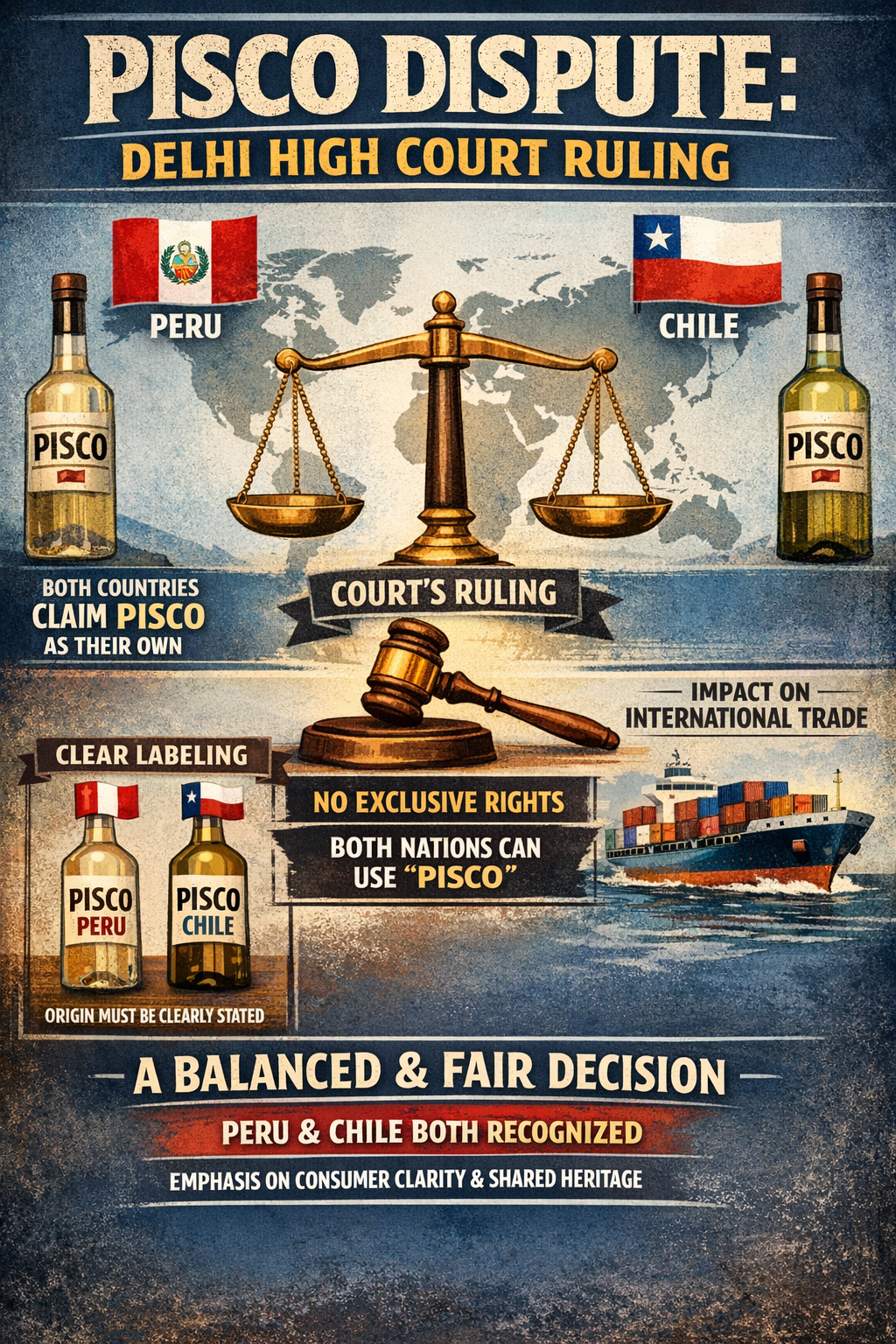
In a significant judgment with global trade implications, the Delhi High Court has dismissed Peru’s plea seeking exclusive rights over the name “PISCO” in India. The court ruled that both Peru and Chile have legitimate historical and commercial claims over the grape-based alcoholic beverage and therefore cannot grant sole ownership to one country.
The case, which dates back to 2005, highlights the complexities of geographical indications (GI) and international intellectual property disputes. By emphasizing fair use and consumer clarity, the ruling sets an important precedent for how shared cultural products are treated in global markets.
Background of the ‘PISCO’ Dispute
The dispute began when Peru applied for Geographical Indication (GI) protection for the term “PISCO” in India in 2005. GI tags are used to identify products that originate from a specific region and possess qualities unique to that location.
Chile opposed Peru’s application, arguing that it too has a long-standing tradition of producing and exporting PISCO. Both countries have historically used the name for their respective grape-based spirits, making the claim highly contested.
Over the years, the issue evolved into a legal battle, reflecting deeper economic and cultural stakes tied to the beverage.
Explanation:
This section explains the origin of the dispute. It highlights how both Peru and Chile laid claim to the name “PISCO,” leading to a long-standing legal conflict over geographical indication rights.
What Is a Geographical Indication (GI)?
A Geographical Indication is a form of intellectual property that links a product to a specific place of origin. Products with GI status often carry reputational value and are associated with quality, authenticity, and tradition.
Examples include well-known items like regional wines, cheeses, and agricultural products. GI protection helps producers maintain exclusivity and prevents misuse of the name by others.
However, when more than one region claims the same product name, disputes arise, requiring legal interpretation and international cooperation.
Explanation:
This section explains the concept of GI. It helps readers understand why the “PISCO” name is valuable and why countries seek exclusive rights over such terms.
Court’s Observations and Key Ruling
The Delhi High Court carefully examined the historical and commercial use of the term “PISCO” by both Peru and Chile. It concluded that neither country could claim exclusive ownership of the name in India.
The court emphasized that both nations have valid claims, supported by evidence of long-standing production and use. As a result, granting exclusive GI status to one country would be unfair to the other.
Instead, the court directed that both parties can continue using the name, provided they clearly label the origin of their products to avoid consumer confusion.
Explanation:
This section focuses on the court’s decision. It explains why exclusive rights were denied and how the court ensured fairness by allowing both countries to use the name with proper labeling.
Importance of Clear Labeling
One of the key aspects of the ruling is the emphasis on clear and transparent labeling. The court highlighted that consumers must be able to distinguish between Peruvian and Chilean PISCO.
Proper labeling ensures that buyers are informed about the product’s origin, helping them make informed choices. It also reduces the risk of misleading marketing practices.
This approach balances the interests of both countries while prioritizing consumer rights and market transparency.
Explanation:
This section explains the importance of labeling in the ruling. It shows how clear identification helps prevent confusion and protects consumer interests.
Implications for International Trade
The judgment has broader implications for international trade and intellectual property rights. It highlights the challenges of protecting traditional products in a globalized market where multiple regions may share similar histories.
By allowing shared usage of the name, the court has adopted a practical approach that avoids monopolization while respecting historical claims.
This decision may influence future cases involving similar disputes, encouraging collaborative solutions rather than exclusive ownership.
Explanation:
This section discusses the global impact of the ruling. It explains how the decision could shape future international trade and GI-related disputes.
Peru vs Chile: A Cultural and Economic Rivalry
The dispute over “PISCO” is not just legal but also cultural and economic. Both Peru and Chile consider the beverage an integral part of their national identity.
For Peru, PISCO is deeply rooted in its heritage and is often associated with traditional production methods. Chile, on the other hand, has developed a significant export market for its version of the drink.
This rivalry reflects the broader importance of branding and heritage in the global economy, where product identity can influence market success.
Explanation:
This section highlights the cultural and economic dimensions of the dispute. It explains why both countries are invested in claiming the name.
India’s Role in GI Disputes
India, as a growing market and a country with its own rich tradition of GI products, plays an important role in such disputes. The legal framework governing GI protection ensures that claims are evaluated based on evidence and fairness.
The Delhi High Court’s decision demonstrates India’s balanced approach to international intellectual property issues. It shows a willingness to consider multiple perspectives and avoid biased outcomes.
Such decisions enhance India’s credibility as a fair and transparent legal jurisdiction.
Explanation:
This section explains India’s role in handling GI disputes. It highlights how the country’s legal system contributes to fair decision-making.
Challenges in Protecting Shared Heritage
The “PISCO” case underscores the difficulties of assigning exclusive rights to products with shared origins. Historical overlaps, migration, and cultural exchanges often blur the lines of ownership.
In such cases, strict exclusivity may not be practical or fair. Instead, solutions like shared recognition and clear labeling can provide a balanced outcome.
These challenges highlight the need for evolving legal frameworks that can address complex global realities.
Explanation:
This section discusses the broader challenges of protecting shared heritage. It explains why traditional legal approaches may need to adapt to modern circumstances.
Conclusion: A Balanced and Forward-Looking Judgment
The Delhi High Court’s decision on the “PISCO” dispute represents a thoughtful and balanced approach to a complex issue. By rejecting Peru’s claim for exclusive rights and recognizing the legitimacy of both Peru and Chile, the court has upheld principles of fairness and equity.
The emphasis on clear labeling ensures that consumer interests remain protected while allowing both countries to continue their trade practices. This ruling not only resolves a long-standing dispute in India but also sets an example for handling similar cases globally.
As international trade continues to expand, such decisions will play a crucial role in shaping how countries navigate shared heritage, intellectual property, and market competition.
thedigitshub.com thedigitshub.com thedigitshub.com thedigitshub.com thedigitshub.com thedigitshub.com thedigitshub.com thedigitshub.com thedigitshub.com thedigitshub.com thedigitshub.com thedigitshub.com thedigitshub.com thedigitshub.com thedigitshub.com thedigitshub.com thedigitshub.com thedigitshub.com thedigitshub.com thedigitshub.com thedigitshub.com thedigitshub.com thedigitshub.com thedigitshub.com thedigitshub.com thedigitshub.com thedigitshub.com thedigitshub.com thedigitshub.com thedigitshub.com thedigitshub.com thedigitshub.com thedigitshub.com thedigitshub.com thedigitshub.com thedigitshub.com thedigitshub.com thedigitshub.com thedigitshub.com thedigitshub.com thedigitshub.com thedigitshub.com thedigitshub.com thedigitshub.com thedigitshub.com thedigitshub.com thedigitshub.com thedigitshub.com thedigitshub.com thedigitshub.com thedigitshub.com thedigitshub.com thedigitshub.com thedigitshub.com thedigitshub.com thedigitshub.com thedigitshub.com thedigitshub.com thedigitshub.com thedigitshub.com thedigitshub.com thedigitshub.com thedigitshub.com thedigitshub.com thedigitshub.com thedigitshub.com thedigitshub.com thedigitshub.com thedigitshub.com thedigitshub.com thedigitshub.com thedigitshub.com thedigitshub.com thedigitshub.com thedigitshub.com thedigitshub.com thedigitshub.com thedigitshub.com thedigitshub.com thedigitshub.com thedigitshub.com thedigitshub.com thedigitshub.com thedigitshub.com thedigitshub.com thedigitshub.com thedigitshub.com thedigitshub.com thedigitshub.com thedigitshub.com thedigitshub.com thedigitshub.com thedigitshub.com thedigitshub.com thedigitshub.com thedigitshub.com thedigitshub.com thedigitshub.com thedigitshub.com thedigitshub.com thedigitshub.com thedigitshub.com thedigitshub.com thedigitshub.com thedigitshub.com thedigitshub.com thedigitshub.com thedigitshub.com thedigitshub.com thedigitshub.com thedigitshub.com thedigitshub.com thedigitshub.com thedigitshub.com thedigitshub.com thedigitshub.com thedigitshub.com thedigitshub.com thedigitshub.com thedigitshub.com thedigitshub.com thedigitshub.com thedigitshub.com thedigitshub.com thedigitshub.com thedigitshub.com thedigitshub.com thedigitshub.com thedigitshub.com thedigitshub.com thedigitshub.com thedigitshub.com thedigitshub.com thedigitshub.com thedigitshub.com thedigitshub.com thedigitshub.com thedigitshub.com thedigitshub.com thedigitshub.com thedigitshub.com thedigitshub.com thedigitshub.com thedigitshub.com thedigitshub.com thedigitshub.com thedigitshub.com thedigitshub.com thedigitshub.com thedigitshub.com thedigitshub.com thedigitshub.com thedigitshub.com thedigitshub.com thedigitshub.com thedigitshub.com thedigitshub.com thedigitshub.com thedigitshub.com thedigitshub.com thedigitshub.com thedigitshub.com thedigitshub.com thedigitshub.com thedigitshub.com thedigitshub.com thedigitshub.com