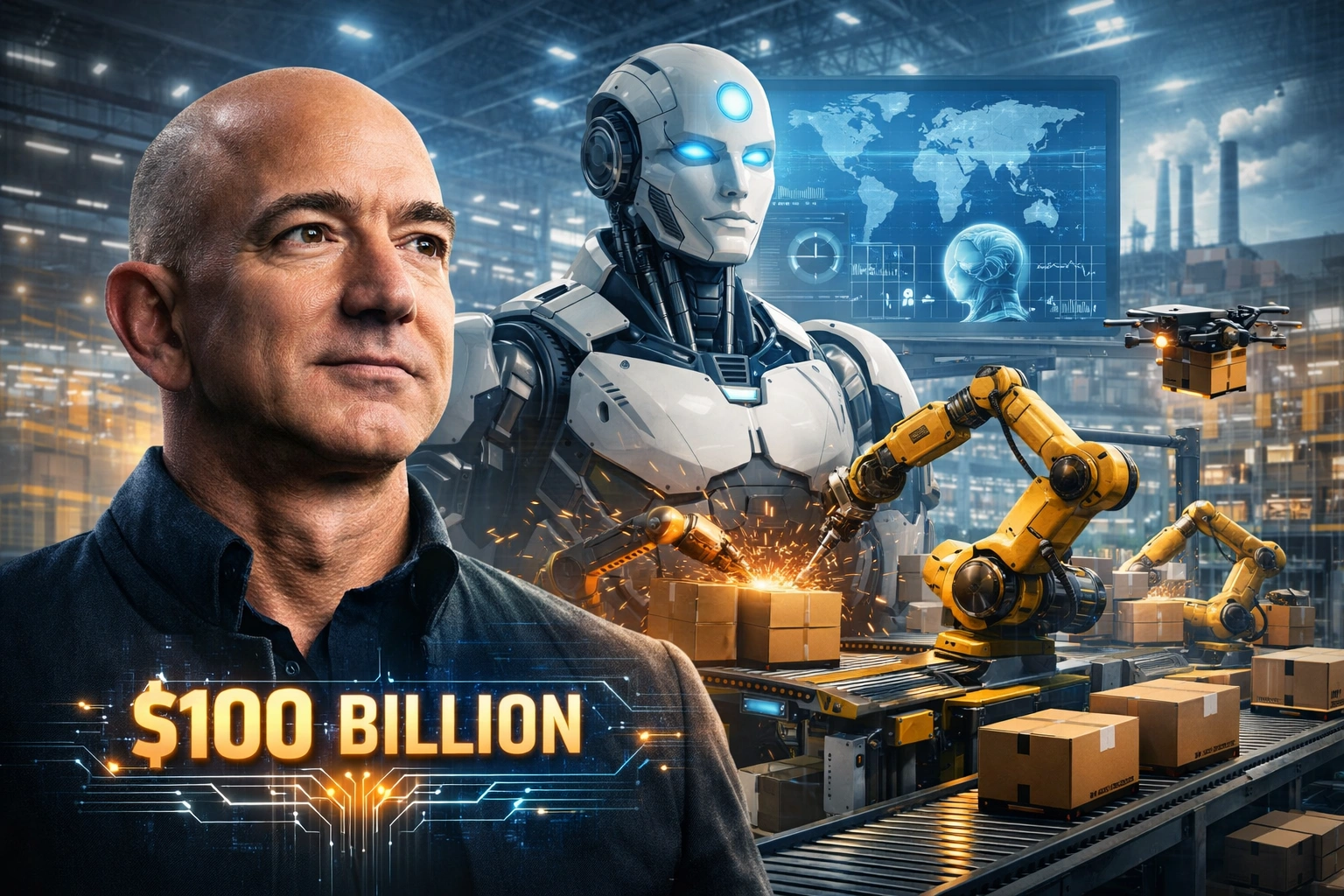
The global industrial landscape is on the brink of a major transformation as Jeff Bezos prepares a massive $100 billion investment into artificial intelligence (AI). This ambitious move is not just another tech initiative—it represents a fundamental shift in how factories and warehouses operate. By integrating AI deeply into physical industries, Bezos aims to redefine production systems, streamline operations, and significantly reduce reliance on human labor.
Recent reports indicate that this initiative focuses on acquiring existing manufacturing firms and rebuilding them around AI-driven systems. The scale and intent of this strategy suggest that automation is entering a new phase—one where machines are not only assisting humans but potentially replacing them in large numbers.
The Vision Behind the $100 Billion Investment
Jeff Bezos is reportedly in early discussions to raise up to $100 billion for a new investment fund aimed at transforming manufacturing through AI. Instead of building companies from scratch, the strategy involves acquiring established firms and modernizing them using advanced technologies.
This approach reflects a practical understanding of industrial challenges. Existing companies already possess infrastructure, workforce knowledge, and supply chains. By layering AI systems on top of these foundations, the transformation can be faster and more scalable.
The ultimate goal is not just efficiency but reinvention. Bezos envisions factories that rely heavily on intelligent systems capable of decision-making, predictive analysis, and autonomous operation. This could lead to a dramatic shift in how industries function globally.
Project Prometheus: The Core of Industrial AI
At the center of this initiative lies Project Prometheus, an AI venture co-led by Bezos. Unlike traditional AI models that focus on text or digital data, this project emphasizes understanding the physical world.
Prometheus is developing systems that can simulate real-world behavior, such as predicting how materials react under stress or how airflow impacts machinery. These capabilities are critical in industries like aerospace, chip manufacturing, and automotive production.
By enabling machines to “think” about physical processes, the technology reduces the need for repeated testing and manual intervention. This represents a significant leap from current automation, which still relies heavily on human oversight.
Transforming Factories and Warehouses
The primary focus of Bezos’ plan is to bring AI deeper into factories and warehouses. These environments have already seen automation through robotics, but the next phase involves intelligent systems managing entire workflows.
In warehouses, AI can optimize inventory management, predict demand, and control robotic systems that handle sorting and packaging. In factories, it can oversee production lines, detect defects using computer vision, and prevent equipment failures through predictive maintenance.
This level of integration allows operations to run faster, more accurately, and with fewer disruptions. Over time, the reliance on human workers for routine and repetitive tasks could decline significantly.
The Strategy: Acquire, Automate, and Optimize
Bezos’ strategy is built on three key steps: acquiring companies, implementing AI systems, and optimizing operations. This approach allows for rapid deployment of technology across multiple industries.
Rather than competing with existing manufacturers, the plan is to transform them from within. Once acquired, these companies can be restructured to leverage AI for everything from supply chain management to product design.
The advantage of this model lies in its scalability. With sufficient funding, multiple companies across sectors like aerospace, defense, and semiconductors can be upgraded simultaneously, creating a network of AI-driven enterprises.
The Impact on Jobs and Workforce Dynamics
One of the most significant concerns surrounding this initiative is its impact on employment. As AI systems become capable of performing both physical and cognitive tasks, many traditional roles in factories and warehouses could become obsolete.
Jobs that involve repetitive manual labor or routine decision-making are particularly at risk. Tasks that once required teams of workers may be handled by machines operating with minimal supervision.
However, this shift does not necessarily mean the complete elimination of human work. New roles may emerge in areas such as AI maintenance, system design, and data analysis. The challenge lies in transitioning the workforce to these new opportunities.
Industry-Wide Implications and Competition
Jeff Bezos is not alone in pursuing AI-driven industrial transformation. Other tech leaders and companies are also exploring automation in manufacturing and logistics. This growing competition highlights the strategic importance of AI in the future of industry.
The scale of Bezos’ investment, however, sets it apart. A $100 billion fund would rank among the largest private investment efforts in industrial history. If successful, it could establish a new standard for how manufacturing businesses operate.
Additionally, this initiative aligns with broader trends in global supply chains. As countries seek to strengthen domestic production capabilities, AI-driven efficiency could make local manufacturing more competitive.
Challenges and Risks of Large-Scale Automation
Despite its potential, the plan faces several challenges. Manufacturing environments are complex, with variables that are difficult to model accurately. Integrating AI into these systems requires not only advanced technology but also significant organizational change.
There are also regulatory, economic, and social considerations. Labor laws, environmental regulations, and union dynamics can complicate the transformation process. Furthermore, the high cost of implementation means that returns on investment may take years to materialize.
Another critical risk is over-reliance on technology. While AI can improve efficiency, it may also introduce vulnerabilities, such as system failures or cybersecurity threats.
The Future of Industrial Automation
Bezos’ $100 billion bet signals a broader shift toward what can be described as “intelligent automation.” Unlike earlier waves of mechanization, this phase combines robotics with advanced AI, enabling systems to adapt, learn, and make decisions.
If successful, this approach could redefine productivity standards across industries. Factories may become largely autonomous, warehouses could operate with minimal human intervention, and supply chains might be managed entirely by intelligent systems.
At the same time, this transformation raises important questions about the future of work, economic inequality, and the role of humans in an increasingly automated world.
Conclusion
Jeff Bezos’ plan to invest $100 billion in AI-driven industrial transformation represents one of the most ambitious technological initiatives of our time. By focusing on factories and warehouses, the strategy targets the backbone of the global economy.
While the potential benefits include increased efficiency, reduced costs, and faster production, the implications for employment and society are profound. As AI continues to evolve, businesses, governments, and workers must adapt to a rapidly changing landscape.
Ultimately, this initiative is not just about technology—it is about redefining how industries operate and how humans fit into the future of work.