A massive pro-Khalistan rally in Montreal, Canada, drew over 500 vehicles this week, as supporters of the separatist movement demonstrated ahead of a planned “Khalistani referendum.” The rally marked another public display of the Khalistan movement’s activity among sections of the Sikh diaspora, coming amid ongoing diplomatic tensions between India and Canada.
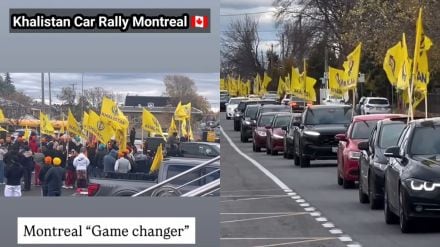
The demonstration was organized by pro-Khalistan groups aligned with the Sikhs for Justice (SFJ) organization — a group banned in India but active in several Western countries. The event, characterized as a “referendum awareness drive,” involved a long convoy of vehicles adorned with Khalistan flags and banners, moving through Montreal’s main roads under heavy police monitoring.
A Massive Show of Strength
According to reports from local media and eyewitnesses, more than 500 cars and trucks participated in the rally, creating traffic disruptions in parts of the city. Participants carried yellow and blue flags bearing the Khalistan emblem and displayed posters of separatist leaders.
The rally began in the suburbs of Montreal and moved toward the downtown area, with organizers claiming it was a “peaceful mobilization” meant to “educate the Sikh community” about the upcoming phase of the Khalistan referendum.
Police were deployed in large numbers to ensure order and prevent any clashes. While no major incidents were reported, security agencies maintained a strong presence throughout the rally route.
companybusinesses.com | elitebizcore.com | brightbizzone.com
businesjoy.com | businesbliss.com
Timing and Political Context
The rally comes at a time of heightened diplomatic strain between India and Canada following a series of controversies involving Khalistani activities. India has repeatedly accused Canada of allowing extremist groups to operate freely on its soil under the guise of freedom of expression.
The issue gained global attention in 2023 after Canadian Prime Minister Justin Trudeau’s government accused India of involvement in the killing of Hardeep Singh Nijjar, a designated Khalistani extremist, outside a gurdwara in British Columbia. India strongly rejected the allegations, calling them “absurd” and “politically motivated.”
Since then, both nations have witnessed a deterioration in diplomatic relations, with India suspending visa services for Canadian citizens for several weeks and expelling senior diplomats.
The latest rally adds to growing concern that Khalistani separatist activities in Canada are gaining renewed visibility, potentially deepening the rift between the two countries.
Key Organizers and Figures
The event reportedly drew supporters linked to Gurpatwant Singh Pannun, the self-proclaimed leader of the Sikhs for Justice (SFJ) group, and Inderjeet Singh Gosal, another figure associated with pro-Khalistan campaigns.
Both men have been known for making provocative statements against Indian officials, including threats directed at National Security Adviser (NSA) Ajit Doval earlier this year. Indian security agencies have labeled Pannun a designated terrorist under the Unlawful Activities (Prevention) Act (UAPA) and have sought international cooperation to curb his activities.
According to Indian intelligence sources, the Montreal rally is part of a broader attempt by Pannun and his associates to keep the Khalistan issue alive internationally, especially in countries with large Sikh populations such as Canada, the United Kingdom, and Australia.
Law Enforcement and Security Measures
Canadian authorities, while permitting the rally under the country’s laws guaranteeing freedom of speech and assembly, closely monitored the event due to its sensitive nature. Police vehicles accompanied the procession, and drones were used to observe crowd movement and ensure no violence erupted.
Officials confirmed that no arrests were made during the demonstration, but intelligence agencies are reviewing the footage for any signs of hate speech or incitement.
A spokesperson for the Montreal Police Service stated,
“Our primary goal was to ensure public safety and freedom of expression while maintaining peace. The rally proceeded without incident, and traffic was managed as efficiently as possible.”
However, many Indian community leaders in Canada criticized the event, calling it “provocative” and “deeply divisive.”
Reaction from India
In New Delhi, government officials expressed serious concern over the rally, calling it a “disturbing development” that reflects Canada’s inaction against extremist elements.
A senior Indian diplomatic source said,
“Despite repeated warnings and evidence shared by India, Canada continues to provide a platform for extremist propaganda that threatens our national security and bilateral ties.”
India’s Ministry of External Affairs (MEA) is expected to raise the issue formally with the Canadian High Commission in New Delhi, urging the government in Ottawa to curb activities that glorify separatism or promote violence.
Impact on India-Canada Relations
This latest rally could further strain India-Canada relations, which have been on shaky ground since 2023. India maintains that Khalistan-related activities abroad are not just political demonstrations, but efforts to revive a violent separatist movement that claimed thousands of lives in Punjab during the 1980s.
For Canada, the issue poses a domestic political dilemma. The country is home to one of the largest Sikh populations outside India, with significant influence in several constituencies. Balancing civil liberties and national security concerns has become increasingly difficult for the Trudeau administration.
Political observers note that while Canada’s government has condemned violent extremism, it has refrained from explicitly naming or banning groups like Sikhs for Justice, citing free speech protections.
Community Reactions in Canada
The rally has sparked mixed reactions within the Canadian Sikh community. While a segment of activists continues to support the referendum campaign as a form of “political expression,” many mainstream Sikh organizations have distanced themselves from the Khalistan narrative.
Prominent community members emphasized that most Canadian Sikhs are peace-loving citizens who contribute positively to Canadian society and do not support any separatist or violent agendas.
“Such rallies damage our community’s image,” said Harjit Sandhu, a Sikh community leader in Toronto. “We are proud of our heritage, but promoting separatism only divides us further.”
International Implications
The pro-Khalistan movement’s activities in Western countries have drawn global scrutiny. India has urged governments in the UK, Australia, and the US to monitor such groups, warning that their networks could be used to fund or inspire extremist actions in South Asia.
Experts say the repeated rallies, propaganda events, and “referendum drives” are aimed at maintaining relevance for a declining separatist cause, while leveraging international political freedoms to promote anti-India narratives.
Several Western governments, while defending free speech, have expressed concerns about the potential for violence linked to such movements.
Conclusion
The Montreal rally featuring over 500 vehicles is one of the largest pro-Khalistan demonstrations in recent months, signaling that the movement’s organizers continue to enjoy visibility and mobilization capacity abroad.
While the rally passed peacefully, its political symbolism carries significant implications. For India, it reinforces the urgency of addressing anti-India extremism overseas; for Canada, it highlights the challenge of balancing free speech with public safety and international diplomacy.
As both nations navigate this tense phase, the recurring Khalistan activities risk keeping bilateral relations under constant strain, unless firm diplomatic and law enforcement measures are undertaken.